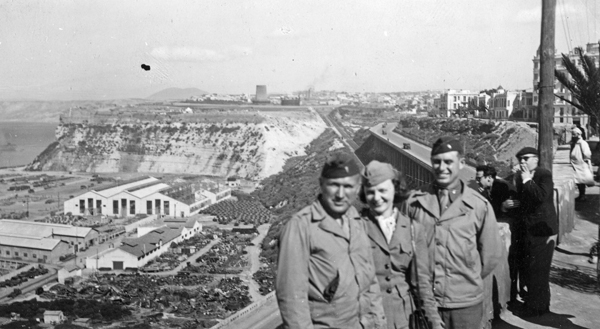
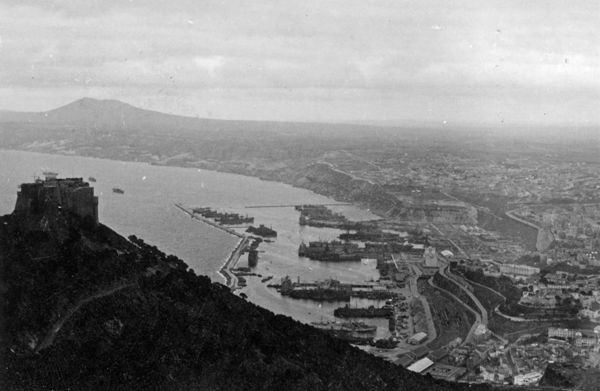
The rainy morning of December 28, 1942, 8 U.S. Army Air Force officers and 48 enlisted men disembarked from the troop carrier U.S.S. Elizabeth C. Stanton at the Port of Oran, Algeria and were transported by trucks to the newly designated 12th Air Force Replacement Pool. This group of soldiers were part of the assault on North Africa which had begun with Operation Torch on November 8th, 1942. The port of Oran was second only to the port of Algiers for the debarkation of Allied divisions and their supporting units with thousands of tons of supplies being unloaded daily to meet the needs of Operation Torch.
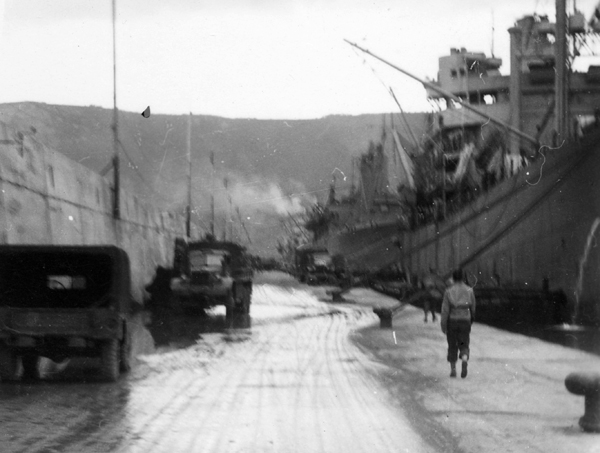
The U.S.S. Elizabeth C. Stanton dockside in the port of Oran.

My Grandfather, after OCS training was a commissioned 2nd Lt. and issued a bedroll, two extra blankets and a roll of toilet paper in addition to his mess kit, uniform, boots, helmet, heavy coat and rain gear when they shipped out of Bolling Field, Stateside. After crossing the Atlantic and spending a couple weeks in England, they walked off the troop carrier and drove 42km just West of the Oran port where they stayed for 5 days, sharing a tent with Cpt. Anderson, a mid 40’s WW I retread who had taught in public schools on the East Coast until re-enlisting to fight in WW II.
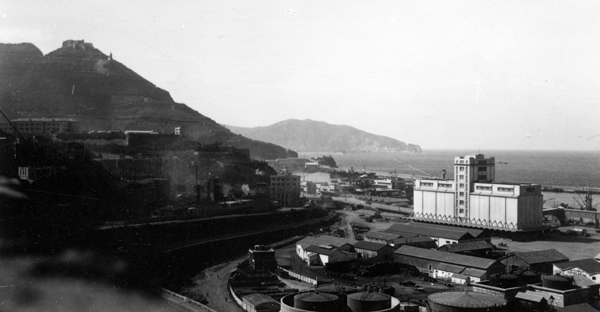
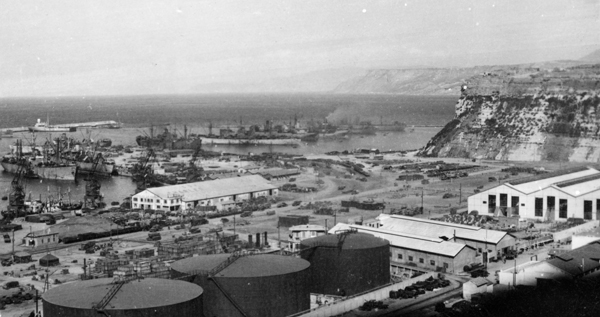
The 5th rainy morning after arrival in Algeria saw new orders to transfer to the 12th Air Force headquarters in Algiers where my Grandfather was to be the new motor pool officer for II SAC and supply officer for the base squadron. He was picked up by a young Sgt. Picard who introduced him to Lt. Salvatore Bianco who reported to a gentleman named Leland Rounds. Sgt. Picard and Lt. Bianco then took him to his briefing with a Lt. Colonel Myers, adjutant to Col. Ayling, Commanding Officer of Second Service Area Command and Col. Beverly, his Chief of Staff. This was an interesting group of people. Sgt. Picard seemed fluent in French, Italian and Spanish along with some Arabic and the man he reported to, Leland Rounds was a former flyer in the Lafayette Escadrille during WW I and subsequently joined Army Intelligence investigating Communist and Nazi involvement in the National Maritime Union. It turned out that both Lt. Bianco and Sgt. Picard were assigned to the Office of Strategic Services (OSS) under the direction of Leland Rounds who headed up the station in Oran, but at the time of this meeting was in Algiers. Further questioning of the two revealed that Lt. Bianco’s parents were from Torino where his father worked as a metallurgist for Fiat. However, in the mid 1930’s as the fascist movement started spreading through Europe, Lt. Bianco, his parents and his two younger brothers emigrated to the United States where his father took a job with the Caterpillar Tractor Company in Peoria, IL. Lt. Bianco attended Purdue University, earned his degree in mechanical engineering and went to work for Caterpillar where he was recruited by the OSS. Sgt. Picard’s Grandfather was born and raised in Marsaille and worked at the Singer Sewing Machine Company, ending up heading up sales for most of North Africa, Greece and Turkey. His Dad inherited the franchise and maintained a headquarters in Alexandria where he had a side business selling seed throughout the region. On a trip to DeKalb, Illinois to check on a new variety of corn, he met Sgt. Picard’s Mother, fell in love, married her and brought her back to Alexandria. Sgt. Picard himself and his younger sister was born in Marsaille, moved to be with their father in Alexandria where they learned French and English and also picked up Arabic from their servants and the street kids. When things started getting tough in Europe in the mid 30’s, his Dad packed up the family and shipped them back to Illinois where Picard finished high school and got in two years at Chicago University before being recruited by the OSS.
To Be Continued…
What an amazing post. Its terrific you have these photos. My grandfather served in France, but I don’t recall seeing any photos. Great post!
Thanks Kris. See if you can find any photos that document your Grandfathers time in France and get them online. This is history that is slipping away, one life, one photograph, one diary at a time.
My father was stationed at Oran 1942-44. He was with the 1st QM Co. of the 1st Infantry Division. Apparently, those with a motor transport background were taken from the 1st Iinfantry Div. and transferred to the Transportation Corps. He ended up doing convoys (PBS) for two years in Africa and one in Leghorn. I’m interested in how and when were the trucks and personnel taken from the 1st Inf. Div. in order to find out his movements and transfers. After these men left the divisions, their contributions are left practically untraceable. I have a picture of Stephen Cherry in the dock warehouses and a picture of his black driver and truck guard with a partial bumper unit marking (xBS 2SUxx)
Ray N. Cherry
Hello Ray,
I would love to see any photographs you may have. Trying to track down details are absolutely difficult. My Grandfather was all over North Africa and then Italy, Yugoslavia and other places it seems. I am going through the photographs as I can to pull out details. More posts coming.
Ray Cherry here,
I just bought a new printer-scanner. I will post the pictures that might interest a general audience doing research. Bumper markings are an important clue and shoulder patches. It’s a fasinating puzzle, like detective work and more interesting. Plus, there is practically no info on men of the service units even though they were shelled and involved in combat. The Germans shelled some of these ports when the supplies were being loaded. Dad saw a black guy get decapitated from one of these rounds. TC truckers did come under attack. Interestingly, the Eisenhower Library has microfilms of the unit diary of the 1st Inf. (about 350 reels), so does the National Archives that probably house the originals. A person could spend weeks researching those films. The 1st’s museum near Chicago would make a good research trip. Incidentally, I just bought on Amazon an original 1945 city map of Leghorn where Dad guarded SS prisoners of the 16th SS Panzer and 34 SS Infantry. PBS men had many duties and almost nothing is recorded. Army at Dawn was a first step, but it’s mostly about the boring big shots, not the Ernie Pyle ordinary Joe’s. Post your photos and I’ll give them the once over. It’s the details that many overlook that can reveal a remarkable story. The veterans of North Africa and Italy are not forgotten.
I’ll totally look forward to seeing any images you have.
I sent pictures last week to your e-mail because I didn’t know how to “attach” in the reply area. Did you get them? I didn’t know if the picture caption area came through.
Thanks,
Ray N. Cherry
Hello Ray,
Yes I did receive your email. Just been buried under tons of work, but will get back to you asap.
I just received Tools of War about the Peninsular Base Section, the giant logistics organization that helped make the victory in Italy possible. Amazon has only one left as far as I can determine. The original references can cost. This was $64, but it came with a lot of photos taken by a signal company that was stationed in Leghorn. I had no idea how big the supply effort was. Some of the Transportation Corps’ truck units were the ancestors of the Red Ball Express. This is a black hole in American history.
CARL (Combined Arms Research Library) Digital recently published copies of original Peninsular Base Section memos as I mentioned before. They have unit codes and locations. Tools of War has the pictures. A diary, From Oak Valley to the Po Valley, on the Net refers to dump/destination locations mostly not identified. CARL Digital identifies them.
If a Baby Boomer saw their Dad’s unit patch as an onion dome with a star in it, that was the giant Peninsular Base Section responsible for Italy. The Fifth Army was entirely different because it was a combat unit. If D-Day was any indication with 90% of men supplying the effort, it could mean that 90% of the men in North Africa and Italy aren’t recognized by history.
Ray N. Cherry
Please contact me Off-Thread via email.
Done.