
I don’t always endorse products online, but when I do, they kick ass.
The idea is simple, but like most things, the execution and success of this particular product is in the thought and details. The founders of Luma Labs, Greg Koenig and James Duncan Davidson have invested a phenomenal amount of thought, trial and error and sweat equity into this product and it shows.
Some history:
Honestly, when my friends Duncan and Greg told me they were going to start a company that manufactures and sells camera straps I thought and perhaps even verbalized… “good luck with that”. But in the intervening time, I have been absolutely stunned at how essential a well designed camera strap has become. My initial thoughts were, “my camera comes with a strap already… why in the world would I buy another one”. But it seems that in the rush to develop newer and better cameras, companies like Canon, Nikon, Olympus, Fuji, Sony and Leica have completely forgotten that one of the most crucial interfaces between the human and the camera was in fact, the camera strap. This oversight has resulted in no thought or innovation by the camera manufacturers into what an indispensable component the camera strap is to those who spend *lots of time* with their cameras outside of perhaps, a studio.
I have been using camera straps from Luma Labs in various iterations since, oh… version zero point five or so and relied upon them to carry my cameras around the globe for about three years now. I’ve used Luma camera straps hanging out the open doors of helicopters, on embeds with the 3rd Special Forces Group and on the tipping and rolling conning tower of a strategic nuclear submarine heading out into open ocean at full speed as well as in the demilitarized zone between North and South Korea. These straps have carried my cameras up and down mountains in China, through the city streets in France, Germany, Argentina, Ireland, Scotland and England, not to mention all over North America and I can think of no other camera strap that would have been as comfortable, nor as reliable and safe for my gear as the camera straps made by Luma Labs.
For those of us who do spend lots of time with our cameras, we start to appreciate what an afterthought the standard camera strap is that typically ships with a multi-hundred or even multi-thousand dollar camera. Luma Labs looked at this problem and said “we can do better than that”. And in true innovative style, they designed a better product called the Luma Loop. The camera strap that emerged from this initial effort was an amazingly well designed device that functioned as a single point sling modeled after a rifle sling patented in the late 1800’s.
The Luma Loop itself was a marvel with high quality materials, laser etching, gorgeous webbing and spectacular engineering. Example: a push button on the D-ring that engaged a cam, allowing 4 ball bearings to retract, thus allowing the cap to release from the D-ring on the strap. It was beautiful to behold and worked like a charm and was sturdy enough that hanging my full body weight of 185 lbs from it would not unintentionally open it. Other companies solutions had cheap straps that cut into your neck or had cheap quality swivels that would rapidly wear and potentially, catastrophically send your high dollar digital SLR and lens to the ground.

So, it was with eager anticipation that I looked forward to the release of the revised Luma Loop only to be crushed when a competitor (who made the low quality straps) threatened lawsuit over simply absurd grounds that perpetuate abuse of the patent system. Its a sad story that is covered in some detail here and in greater detail here so there is no point in rehashing it on this post. The good news is that this threat hastened the development and release of the best camera strap on the market… The Cinch.
The Cinch:
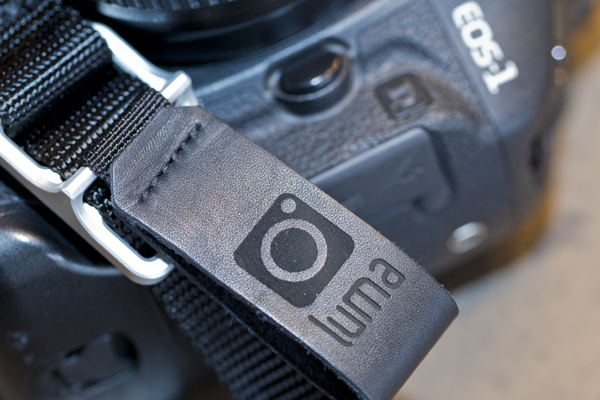
This is the *new* product from Luma Labs, the Cinch. Once you use it, you will never want to go back to a traditional camera strap again. Its perfect for both comfortably carrying your camera as well as moving around, walking or even running while keeping the camera stable and close to your body. The secret to the Cinch is a sliding pull tab that easily lets you adjust the length of the strap to loosen the strap for shooting or tighten the strap up to hold your camera close to your body for walking or for stability when shooting in low light.
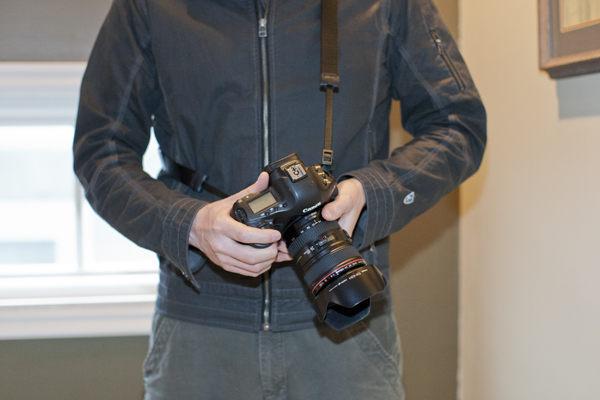

The format of the Cinch is simple with attachment points on your standard camera strap mount, but also to the tripod mount at the bottom of the camera to naturally position the camera for access as well as stability when carrying it. Other companies that have a single attachment point at the bottom of the camera on just the tripod mount result in your camera hanging upside down at awkward angles, which for anyone who may need rapid access to their camera is a bit of a problem. The design of the Cinch is an evolution from the single point design and is intended to be worn across the chest while providing a stable position to rapidly retrieve your camera from. Incidentally, since you won’t carry a camera that is not comfortable, the Cinch has been extensively tested with a variety of body sizes on men and on women with varying chest sizes to optimize the design for comfort as well as camera stability and safety.
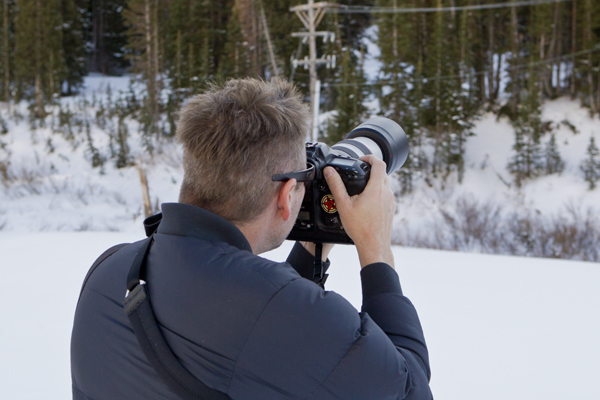
The Cinch can also be easily and quickly snugged up against the body to provide a stability point when shooting with longer or heavier lenses or in low light as shown here by Trent Nelson.
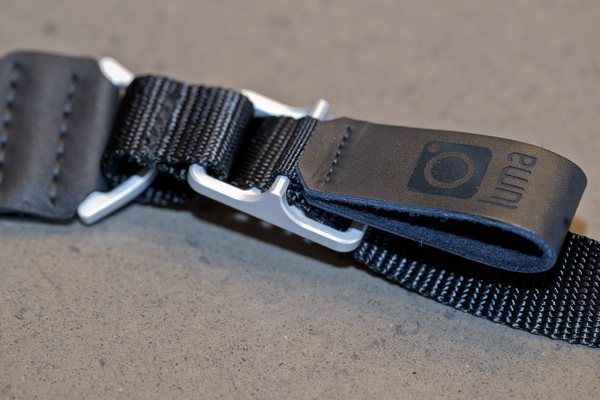
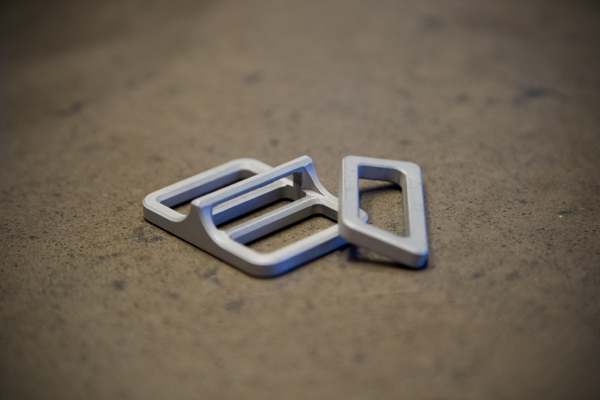
Quality materials are everywhere from the thick, yet soft strap materials, CNC machining of the hardware made from anodized, aerospace grade aluminum that is machined out of 6061-T6 aluminum stock, CNC milled, finished to remove any edges, then type II anodized for a long life and quality feel.

The quality of the Cinch extends to the sewing with double stitching and laser cut leather components. The strap absolutely reeks of quality and well thought out engineering.
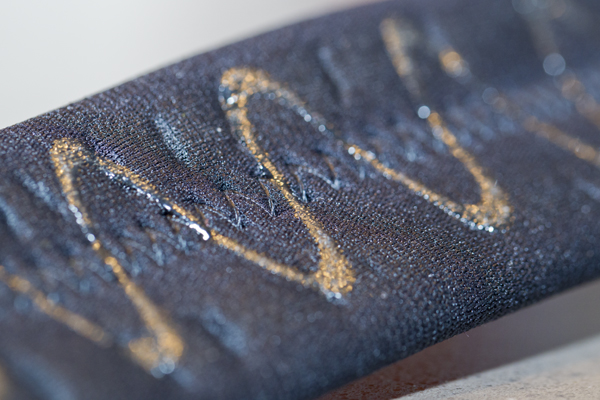
The strap and neoprene pad combination distributes the load of even a substantial camera/lens combination such as the full sized Canon 1D body with a 70-200 f/2.8 lens, a stalwart combination for the photojournalist or sport shooter. When you order the strap, it can be configured for size and weight as well and its also ambidextrous. This strap not only is one of the most comfortable straps out there, it will not slip off your shoulder like many other camera straps when worn over just one shoulder like a traditional camera strap.
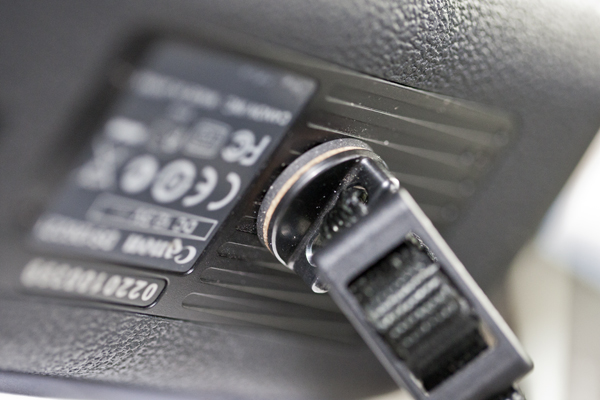
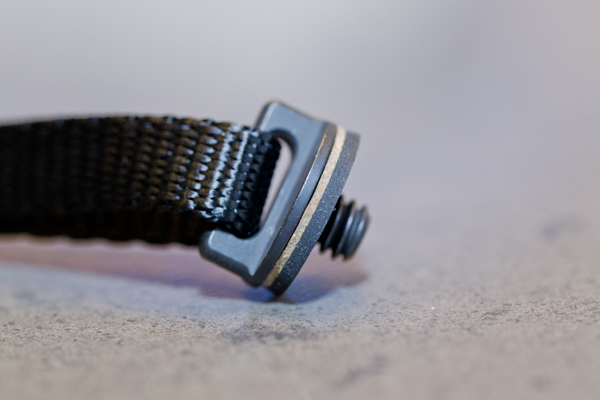
The PodMount that attaches to your tripod mount is also CNC machined and finished for a high quality feel and long life. Quality finish work here prolongs the life of the strap materials and the inclusion of a combination high density neoprene and cork gasket provides for firm, positive connection that will not back out, yet is easy on the fingers to tighten and loosen.
A couple of other points: The Cinch also has softer leather and materials that are close to your camera to eliminate the possibility of scratching your gear. I tend to be pretty hard on my equipment with cameras that get scratched and banged up, but you don’t want your camera strap adding to the injury. The hardware parts that will be closest to the camera are made of a polymer called acetal which is a non-hydroscopic polymer unlike nylon. This is important if you happen to use your camera in adverse weather conditions like rain. These triglide buckle components have a pull strength of about 100lbs and were designed by Grumman engineers back in the mid 60s. It turns out that they are the same 3/8″ triglides that were used by NASA on all their cameras, including the Hasselblad cameras that went to the Moon.
I should also note that as documented on the strap itself, the Cinch is *crafted* in Portland, Oregon. This means that all design, engineering, machining, sewing and assembly happens in Portland, Oregon, USA.

Another important feature of the Cinch is that it is discreet. While many camera straps are festooned with logos (Canon straps are quite obviously being *Canon* straps as are the yellow *Nikon* straps), the Cinch is discreet. Camera gear is expensive and getting more expensive all the time (the subject of another discussion). So, one of the things that most photographers who are serious about their gear do not want to do is bring attention to themselves. The Cinch, while being the best camera strap out there actually decreases ones visual “statement” and helps one to blend into environments a bit better than a “brighter” camera strap might.
Should you get a Cinch? Absolutely. What if you already have an aftermarket camera strap? I’ll guarantee you that this one will be more comfortable, more stable and be more functional that any other camera strap you own.
“festooned ” — perfect.
Heh… I am kinda partial to that word.
As expected from a photographer reviewing camera gear, a lovely set of detailed photos that I could not get from the manufacturer site.
Thanks, getting one.
Thank you Juz,
Its a great product for sure.
Great review Jonesy; won me over for sure. I just ordered one a minute ago all the way from Australia. Good one Portland!
Glad to hear it as will the Luma lab folks I am sure. You are gonna love it.
Great review – thanks for the information, history and close up photos of the CINCH. Now I need to place an order.
Thanks Nathan,
Its the best camera strap I’ve ever owned, so I am sure you will love it.
A user on DPReview mentioned that the setup doesn’t quite work as illustrated when the camera lens is not long enough to keep the camera (and lens) pointed downward and out of the way. That is, if there is a short lens attached, the camera body & lens will face toward the body & potentially scratch the lens, etc.
I like your review although it could have been less biased as in accessing the camera on a Black Rapid strap (& the like) is not really ” a bit of a problem.” It’s just sometimes not rapid enough because the camera has shifted so the grip is not where you’d expect when you reach down to grab it.
I’m still debating about getting a cinch because of the steep price but on the other hand would like to patronize the company for what they’re doing. I’m in Seattle and I’ve actually met the BR guys when I picked a strap up in a hurry at their office and they were nice. That said, I don’t like what they’re doing with this patent “thuggery”. However, it did enable LL to put the thinking cap on and come out with this.
Hey George,
Do you have a link to the DPReview discussion?
You are correct in that you need a little mass to pull the “nose” of the camera down, so a pancake lens might not be ideal for this configuration. But then a pancake lens on something like a 1 series is kinda silly. I’d be curious to try it out on say a Canon Rebel with the 40mm pancake to see how that balances.
With respect to the BR not positioning the camera ideally, I *have* to be able to have the camera grip *precisely* where I expect it. The folks that shoot sports for a living have even more critical needs here. For me, the kinesthetics are very important.
Bryan,
Have you had a chance to use with the pancake? I am considering getting this for a 40d/40mm walk-about setup.
Not yet. I am hoping to borrow a 40mm pancake from a friend. Will let you know.
IS this lense appropriate for a micro 4/3 system such as the Olumpus OM-D-E5? I am going to purchase that system and have an orginal Luma loop for my full size DSLR?
I actually think that it would be perfect for the OM-D because of where the strap lug is. With the Cinch, I’d think that its easier to handle than with a Cinch.
I’m thinking of pairing Cinch with an Oly OM-D E-M5. Did you ever give it a try?
I personally have not, but have heard from others that are more than happy with it.
Thank you for the review! What size Cinch is this pictured in your review? small or regular?
Regular. Though the Cinch is sized for your body. When you order one, you put in size particulars.
Dr. Jones– Upon recommendation from Ben Long (Lynda.com video series), I’m taking a look at the Luma stuff. One suggestion Ben makes is that the strap should have a “quick connect/disconnect” capability so that the camera can be unsnapped, popped onto a tripod, then snapped back onto the strap. I’ve tried looking at the photos and reading your review, but haven’t determined if this Cinch strap has a QD (Quick Disconnect) feature that has been recommended. Can you help clear this up? Many thanks for a great, thorough review. –Dr. Larry S. Anderson Tupelo, MS
Indeed, the strap *should* have a quick connect/disconnect. It’s something that Greg and I are well aware of and are working towards a kick ass solution on. We’ve gone through more than a few almost-there solutions, but we really want to get it nailed the first time out and are taking the time to do it right.
If you simply want to use both the Cinch and a tripod with a quick release plate, there’s a membrane connector that goes between your QR plate and camera which provides a nifty third attachment point. It doesn’t fill all the needs that a quick disconnect system would on the strap, but it goes a long way to making straps (even other straps besides ours) and quick release plates work well together.
Personnally I’m not excited about a quick release unless you can guarantee it will not easily separate. Being a father, I have young kids to carry and one time they released my quick release strap on my BR strap. Never again will I purchase a strap that has a quick strap, hence the reason I purchased the Cinch. One feature I would welcome is a slash proof strap, something similar to the Pacsafe products which I also own. They have steel wires sewn into the their straps which prevents cutting away.
John, what we’ve learned over the years is that straps have to serve a variety of purposes and flexibility is paramount. Certainly the use of a quick disconnect shouldn’t be a requirement for those that need a more secure solution where curious human hands can cause unexpected behavior—such as when you are carrying you children. One of the reasons we haven’t just released an interim quick release solution is because we are wanting to fill as many possible uses—including not using—as possible with as elegant a solution as we can.
Appreciate your time and I do understand being flexible to serve a variety of situations. I might be in the minority with my situation as I rarely have a need to detach my camera for my shooting style. I just need a secure platform that I don’t need to worry about my camera dropping to the floor and the Cinch gives me that peace of mind. Thanks for this great product and looking forward to what you guys have in store for the future.
What is the recommendation when using something on the order of a D300 with a 70-200 f/2.8 zoom? Normally I would want my sling strap attached to the lenses tripod mount so as to not have all the weight of the lens creating stress on the camera mount.
Hey Stu,
I use a Luma Cinch on a 1D body with a 70-200 f/2.8 all the time. There is no need for concern on the camera mount taking the stress as that mount is one of the most robust places for attachment on the camera. I am told that both Canon and Nikon almost never have to perform repairs on the camera mounts as they are over-engineered to take stress and strain. A camera strap is never going to cause you problems there.
If you’d like, you can move the CinchMount attachment (that screws into the tripod socket) to the tripod socket on the lens which will give you a different feel to the carry of your camera/lens combination. But as Bryan says, the lens mount is quite robust and the reason to do this is more for either carrying style or simply to address your own piece of mind.
Thanks guys. This is good to know. Up to now I’ve always supported the rig by the lens to avoid stressing the mount too much. Sounds like I may have been babying it too much.
If you mount the Cinch on one lug on the body and the other on the lens, it will cause stress on the lens mount. While the D300 can probably handle it in this application, the repeated twisting and prying forces are more than you wold normally get in a situation where the camera and lens are statically mounted to a tripod. I think mounting both points of the strap on the body would be a better choice. Your D300 has a robust magnesium chassis, but other cameras with plastic internal chassis could be more of a problem.
Hey Stu,
Yeah, I use the lugs on the camera and have also used the lens mount. These days, for metal frame cameras at least, its probably not a problem. I’ve never had a problem at least. Though with plastic bodied cameras, you are right, that may prove to be a problem. For most users however, using the camera lugs or a podmount on the lens is likely the way to go.
I have two D7100’s that will be paired with either the 17-55 f2.8 or the 70-200 f2.8 VR. After trying strap after strap, I am seriously looking at a Cinch strap. My question is, is there any configuration where I can use one Cinch strap for both cameras with two sets of mounting hardware, one set for each body or wil I have to get two Cinch straps ??
The craftsmanship shown in the photos is impressive. Made in the USA is important to me also….not “sourced” parts put together here but actually made here….but, I almost always wear a backpack, this is a hobby for me not a profession but I do own a 5D MKIII and some heavy lenses so a cheap strap is out of the question. I’ve just started looking at straps and thought a strap like the Luma loop would be the best option with a backpack but I really have no clue….would the cinch be an option ? None of the marketing photos for ANY strap mfg. shows one in conjunction with a backpack. Any thoughts would be appreciated. Thanks in advance.
Regards
I’ve totally worn the Luma Loop in conjunction with backpacks. The loop fits high or low on the shoulder and is, as I’ve said the most comfortable strap made due to the materials and wide area of the cushion.